PLI in Practice: Turning Policy into Production — Realities, Challenges and Strategic Solutions with Adroit
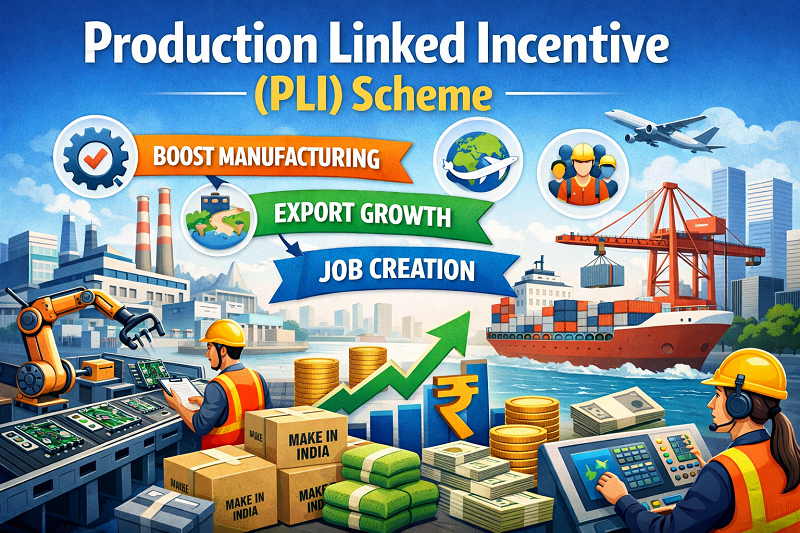
Launched in March 2020, India’s Production Linked Incentive (PLI) Scheme has become one of the most talked after industrial policies in recent times. With an aim to increase production, the scheme incentivises companies based on incremental production and sales rather than traditional upfront subsidies—thereby aligning incentives with actual manufacturing outcomes. It is a cornerstone of the government’s “Make in India” strategies aiming to transform the country into a manufacturing and export powerhouse and establish India as a Global manufacturing hub.
Sectors Covered and Total Outley
The PLI Scheme today spans 14 key sectors, encompassing products ranging from electronics and pharmaceuticals to textiles and specialty steel. The scheme was launched with an aggregate outlay of ₹1.97 lakh crore (approx USD 24 billion) to be deployed over multiple years.
Sectors Include:
- 1. Mobile Manufacturing
- 2. Electronics
- 3. Critical Key Starting Materials/Drug Intermediaries & APIs
- 4. Pharmaceutical Drugs
- 5. Automobiles & Auto Components
- 6. Telecom and Networking Products
- 7. Textiles (MMF & Technical Textiles)
- 8. Food Processing
- 9. White Goods (ACs & LEDs)
- 10. Specialty Steel
- 11. High Efficiency Solar PV Modules
- 12. ACC Batteries
- 13. Medical Devices
- 14. Drones and Drone Components
Applications and Approvals: What the Numbers Say
As of mid-2025:
- 806 applications have been approved under PLI schemes across the 14 sectors.
- Actual investment realised by approved companies runs into ₹1.76 lakh crore, and incremental production/sales attributed to PLI participants have exceeded ₹16.5 lakh crore.
Across sectors, participation levels differ:
- Some sectors like electronics and pharmaceuticals have seen strong uptake and production performance.
- Others, particularly high-technology or capital-intensive segments such as ACC batteries and solar modules, have lagged in achieving production targets.
Key Challenges Faced by Applicants
Despite the strategic design, businesses navigating the PLI framework encounter a range of practical issues:
1. Compliance Intensity & Documentation Burden
Claiming incentives requires companies to submit extensive certifications, including Chartered Engineer attestations, investment proofs, product classification details, and sales verification records. The meticulous nature of these requirements often leads to errors, back-and-forth queries from authorities, and delays in incentive disbursement.
2. Domestic Value Addition (DVA) Requirements
Several sectors have stringent DVA criteria that require a high percentage of inputs to be sourced domestically. For industries with weak domestic supply chains—such as automotive and solar—this becomes a substantial barrier to eligibility.
3. High Thresholds for Investment and Growth
Smaller manufacturers and MSMEs often find the minimum investment thresholds and growth targets difficult to meet, sometimes discouraging participation despite potential benefits.
4. Sectoral Imbalances
Success has been uneven. Core sectors like electronics, pharmaceuticals, food processing, and specialty steel have secured most approvals, whereas “sunrise” sectors like ACC batteries and solar PV modules are slower to achieve operational scale.
5. Eligibility vs. Production Realities
Even when approvals occur, a significant number of firms fail to reach the incremental output thresholds needed to trigger payouts. For example, in the automotive PLI, only about one-fifth of approved firms had qualified for incentive payouts years into the scheme, highlighting operational and compliance bottlenecks.
These issues point towards need for further refinement of the practical execution processes.
How Adroit Helps Clients Navigate PLI Challenges
Adroit is a leading provider of Chartered Engineer services aligned with the requirements of the Government of India’s PLI schemes. We are empanelled with key PSU nodal agencies including SIDBI, IFCI, and LSSSDC.
Our team brings strong technical depth and clarity to every assignment, enabling faster turnaround times while significantly reducing client effort through well-structured, compliant, and unambiguous deliverables. We strictly adhere to applicable policy guidelines and proactively support clients in meeting scheme requirements with confidence and ease.
With a pan-India presence across all major cities, Adroit delivers consistent, reliable, and timely support to applicants nationwide.
Conclusion
The Production Linked Incentive (PLI) scheme has emerged as a transformative policy instrument, driving investments, boosting domestic manufacturing, and strengthening India’s position in global value chains. While the scheme’s design is output-linked, its successful implementation rests heavily on accurate assessment, documentation, and certification of capital investments—an area that has posed significant practical challenges for applicants across sectors. Issues related to capex phasing, commissioning timelines, eligibility interpretation, and certification by authorised agencies have often created uncertainty, delays, and compliance risks.
In this evolving regulatory environment, the role of technically competent and policy-aligned Chartered Engineer service providers becomes critical. By bridging the gap between policy intent and ground-level execution, such professionals enable applicants to focus on production and growth while remaining fully compliant with scheme requirements.
Adroit, with its deep technical expertise, empanelment with key nodal agencies, and pan-India presence, plays a vital role in simplifying PLI compliance for manufacturers. Through structured methodologies, clear interpretations of guidelines, and timely certifications, Adroit helps applicants mitigate risks and reduce delays in report delivery. As India continues to expand and refine its PLI framework, dependable technical partners like Adroit will remain essential to translating policy ambition into sustainable industrial outcomes.
Author:
Amitava Roy | Email: amitava.roy@adroitadvisor.com