
Techno Economic Viability Study as a Strategic Tool for Securing Project Funding from Institutional Investors
Introduction
Techno-Economic Viability Studies, or TEV studies as they are widely recognised in the corporate finance and lending domain, are among the most established techniques for providing confidence to investors and lenders alike, with their origins dating back to the 1950s. They are also known by different names, often localised but referring to the same concept, such as appraisal, bankable feasibility studies, and DPR (in the banking circle in India). The term DPR, or Detailed Project Report, has different connotations as well, often referring to a comprehensive technical manual for a project, which is not the subject of this article and is therefore set aside.
Industrialised nations first realised the need to carry out systematic assessments to understand a project’s ability to generate the desired returns in the early twentieth century. Over time, institutions such as the World Bank developed and published recommended approaches for appraising projects of different natures, including infrastructure projects, large industrial projects, and PPP projects. In the initial decades, appraisals for technical and engineering aspects and for market and financial aspects were carried out separately, a practice that continues even today. Gradually, however, many investors and lenders began to prefer comprehensive assessments of projects in order to evaluate risks, protect their interests, and understand possible mitigation measures.
Most banks and financial institutions prefer to rely on TEV studies carried out by a ‘competent’ ‘third-party’ consultant. The involvement of a third party helps establish that there is no vested interest behind the evaluation, while the requirement of a competent consultant ensures that the project evaluation is in safe and experienced hands.
The same reason also indicative of the level of responsibility perceived to rest with the consultant. The consultant’s experience with the relevant business model, prevailing market conditions, domestic and global political, social, and economic environments, geopolitical impacts, and the influence of local and global supply chains, along with the consultant’s organisational ethical values, remains a matter of paramount importance.
The study and its applicability
These studies, by default, include a comprehensive assessment of the technical and economic aspects of a project and are built around them, leading to an understanding of the project’s potential future performance.
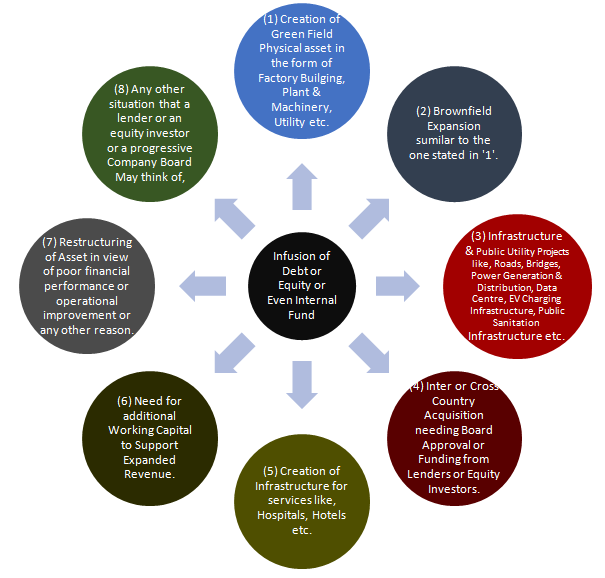
The scenarios that necessitate a TEV study may vary from case to case. In general, the infusion of debt, external equity, or any other financial instrument may trigger the need for such a study. Other linkages and situations that may require a TEV study are illustrated in the following figure.
- changes in the business environment,
- changes in regulations and economic policies,
- supply chain disruptions,
- changes in the technological environment,
- natural calamities, and
- war or similar geopolitical events.
Strategic Benefits of TEV Studies
For Promoters:
- Reaffirmation that the project concept is reasonably dependable.
- Creation and maintenance of a comprehensive project document that can be readily referred to and amended in case of changes in the project.
- A structured opportunity to brainstorm, identify potential issues in the plan, and refine them where required. Addressing challenges proactively is always preferable to dealing with them after they materialise and threaten project sustainability.
For Syndicators and Financial Advisors offering fundraising services:
- It serves as the foundational document that any investor or lender would typically wish to review at the outset.
- A well- structured report covering all essential scope of work items ensures easy acceptances by the lenders or investors.
For Funders and Lenders:
- It provides independent assurance on the viability of the project concept.
- Comfort to the lender and or the equity investors.
What Makes a Good TEV Report?
Now that the need for a study has been explained, it is important to understand what makes a good TEV report from a client’s perspective. In some situations, the definition of “good” is mischievously judged by its ability to raise funds, which is a serious trap that many consultants fall prey to. Having said that, a good TEV study report must demonstrate the following characteristics:
- Independent and unbiased analysis
- Data-backed assumptions
- Realistic financial projections
- Sector-specific risk awareness along with appropriate mitigation suggestions
- Alignment with lender and institutional guidelines (e.g., World Bank, RBI, NABARD norms)
Challenges and Misconceptions
There are several challenges involved in carrying out an independent TEV study. Some of the key challenges are outlined below:
- It is repeatedly emphasised in this article that the assessment and its outcome must be independent and unbiased. The major challenge lies in maintaining this level of objectivity, often under direct or indirect pressure. A consultant’s ability to withstand such pressure and remain unbiased is therefore crucial.
- TEV studies are viewed as a mere formality by many clients, which is both irrational and potentially dangerous for the project. This mindset restricts the free flow of ideas, driven by the notion that money can buy a favourable report. It is the responsibility of a competent consultant to eliminate such misconceptions from the client’s mind in clear and unambiguous terms, at the earliest stage when such a situation arises.
- Some clients appoint consultants primarily based on lower fees, without adequate fact-checking of the consultant’s credentials and the capability of the consultant team. As a result, they often face delayed completion, inappropriate data analysis, poor capture of findings, and, more critically, fallacious assumptions that may lead to extreme and misleading outcomes.
- In certain cases, clients, for various stated or unstated—and sometimes suspicious—reasons, maintain secrecy and do not share complete data or information about the project. Since promoters or developers are the custodians of the project’s basic concept, and the TEV consultant’s role is to re-evaluate the underlying assumptions, such non-disclosure makes it virtually impossible for the consultant to conduct a meaningful study and arrive at an independent opinion. The consequences of this approach are delays and potentially faulty outcomes, for which the consultant cannot be held responsible. There are ways to mitigate this challenge, and execution of a robust Non-Disclosure Agreement (NDA) remains the safest and most effective mechanism.
Selection and the Role of Experienced Consultants
- In the execution of a typical TEV assignment, adoption of a stringent process-oriented approach cannot be overruled. A consulting organisation with strong process management discipline can make a significant difference. While a consulting firm may have a large pool of consultants, what is critical is whether it deploys a team with an appropriate process framework and a clear decision-making hierarchy. Such assignments rarely require a large number of consultants; rather, they require a small team with the right competencies. In practice, the involvement of too many consultants may even lead to confusion and inefficiencies.
- It is essential to verify whether the consultant team deployed for the project possesses the required subject knowledge and relevant experience. Seasoned consultants are better positioned to add meaningful value to the project through informed judgement, practical insights, and well-grounded recommendations.
At Adroit Advisors, we have executed assignments across a wide range of sectors, including steel, aluminium, solar, hydro, thermal power, shipping, chemicals, defence, pharmaceuticals, food processing, battery manufacturing and storage infrastructure, IT infrastructure, mobility, and plastic recycling, among others. These engagements span service categories such as Techno-Economic Viability (TEV) studies, Technical Due Diligence (TDD), Lender’s Independent Engineer (LIE) assignments, and Chartered Engineer certifications under the PLI Scheme, Asset Valuations. We are empanelled with most banks and financial institutions in Indiaand also working closely with international fund houses and international development finance institutions.
Conclusion
Techno-Economic Viability Studies have evolved into a critical strategic tool for investors, lenders, and promoters seeking informed and risk-mitigated project funding decisions. Beyond being a procedural requirement, a well-conducted TEV study provides independent assurance, realistic insights, and a structured understanding of project risks and opportunities. When executed with integrity, robust processes, and experienced judgement, TEV studies not only facilitate funding but also strengthen project design, resilience, and long-term sustainability, thereby protecting the interests of all stakeholders involved.
Author:
Amitava Roy | Email: amitava.roy@adroitadvisor.com